Southeast Compact Commission Pilot Incentivization Program for Unwanted Source Disposal
October 19, 2023: The Source Collection and Threat Reduction (SCATR) Program is an initiative of the Conference of Radiation Control Program Directors. The program is supported by the U.S. Department of Energy National Nuclear Security Agency and provides funding for the disposal of unwanted radioactive sealed sources. The amount of funding available via SCATR varies year by year, but the program is targeting a 40% cost-share amount for 2023-24 program participants.
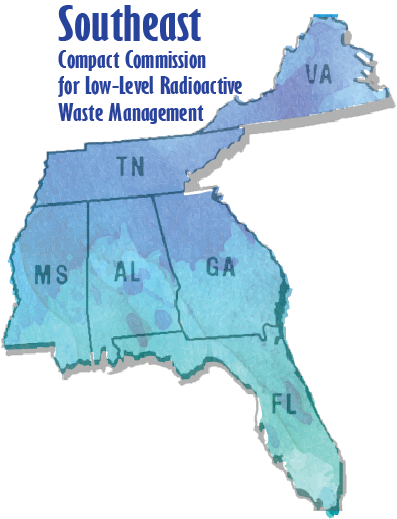
The Southeast Compact Commission is piloting a program aimed at incentivizing its regional source owners to register and dispose of their unwanted and unneeded sealed sources via SCATR. The Commission intends to cost-share an additional 30% of the disposal for sources located in the states of Alabama, Florida, Georgia, Mississippi, Tennessee, and Virginia on a first-come, first-served basis until its available funding for the pilot program is depleted. This means, at least for 2023-24 program participants, that they may only be responsible for 30% of the total disposal cost of their unwanted sources.
To participate in this program, interested parties need only register their unused sources with the Department of Energy Off-Site Source Recovery Program by visiting the online registration page — https://osrp.lanl.gov/PickUpSources.aspx. Participants in qualifying states will be automatically notified when they qualify for cost-sharing from the Southeast Compact Commission.
Questions about this program should be directed to the Southeast Compact Commission’s Executive Director, Dr. Tom Hansen, at 865-228-1997 or tom@secompact.org.

 In 1980, Congress passed the Low-Level Radioactive Waste Policy Act, which provided for a new approach to the disposal of low-level radioactive waste (LLRW) in the United States. It assigned each State responsibility for the disposal of low-level radioactive waste generated within its borders and authorized states to enter into compacts for the purpose of operating regional disposal facilities. The 1980 Act also authorized compacts with existing disposal sites in Nevada, South Carolina, and Washington to stop accepting waste outside of those compact regions after a sufficient period of time had elapsed for the development of new disposal facilities in other compact regions.
Congress amended the Act in 1985 by extending disposal of low-level radioactive waste at the three existing disposal facilities until January 1, 1993, provided that certain milestones were met.
To meet their obligations under the Act, Alabama, Florida, Georgia, Mississippi, North Carolina, South Carolina, Tennessee and Virginia formed the Southeast Interstate Low-Level Radioactive Waste Management Compact in 1983. The number of states in the Compact changed to six with the withdrawal of South Carolina in 1995 and North Carolina in 1999. The compact concept offers the significant advantage of rotating responsibility for the region’s LLRW and maximizing efficient use of available resources to protect public health and the environment.
THE COMMISSION
The Commission oversees the administration and implementation of the Compact agreement. The Commission has three standing committees that make recommendations to the full Commission, which has final authority for all policy decisions. All Commission and committee meetings are open to the public.
The Administrative Committee, after consulting with the Executive Director and Finance Committee, submits a proposed annual budget for adoption, or amendment and adoption, to the Commission annually, analyzes and recommends proposed amendments to the Commission bylaws, and deals with all legal and administrative matters affecting the Commission.
The Policy and Planning Committee develops and recommends long-term Commission goals and the policies, procedures, and activities necessary to implement those goals, including the export of LLRW from the Southeast Compact, the identification of host states, and public awareness and involvement in Commission activities.
The Finance Committee is responsible for maintaining financial records, helping the Commission understand the organizations finances, budgeting, and safeguarding and managing the Commission’s investments and other assets.
Sub-committees are appointed to handle short-term projects and report back to the main committee, and technical advisors are called upon as needed.
MISSION OF THE SOUTHEAST COMPACT COMMISSION
To ensure that adequate, reliable, and appropriate services are available to manage low-level radioactive waste streams generated in the Southeast Compact Region and to promote and facilitate the maximum use of those services by the party states.
(Commission’s Strategic Plan Commission’s Strategic Plan as revised in June 2020)